Individuals or families in New York dealing with serious injuries or wrongful death cases
Who are its main users?
Users seeking trustworthy, compassionate, and responsive legal support
People feeling stressed or uncertain, looking for clarity and reassurance
Clients who value personal attention over big “factory” law firms
Locals who prefer a nearby attorney familiar with New York and Long Island laws
Enhance user experience and clarity of messaging
Modernize the design, incorporate stronger visual cues (such as attorney bios, case results, client testimonials, professional imagery) and ensure consistent branding that reflects the firm’s experience, personalized service and successful track record.
objective
Redesign the site so that visitors immediately understand the firm's value and can easily navigate to key practice areas, results, testimonials and contact forms.
Strengthen brand trust and credibility
Ensure the website is responsive and performs well across smartphones, tablets and desktops - and that content is structured and optimized (site speed, accessibility, SEO best practices) so that potential clients searching for personal injury lawyers in New York and Long Island can find and use the site effectively.
Optimize for mobile and search visibility
Optimize the contact/consultation journey (free case evaluation form, phone numbers, location information) to reduce friction and encourage more prospective clients to engage, thereby increasing the number of qualified leads generated.
Improve conversion and lead generation

What is FODMAP?
They are special carbs that can cause digestive distress especially for people with Irritable Bowel Syndrome (IBS). They can cause gas, bloating, pain and irregular bowel movements. This condition can be controlled by a Low-FODMAP Diet.
Who is the target user?
The target user consists of individuals managing digestive distress like IBS and are caught in a cycle of trial and error to identify food triggers. They seek simple, reliable dietary guidance, whether for home cooking or takeout to minimize symptoms like bloating and pain. Their ultimate goal is to regain a sense of normalcy and lifestyle freedom through predictable, gut-friendly food choices.
01
Fodi App
Research
FODI CASE STUDY
User Experience & User Interaction
Completed alongside the Mobile UI Design course from Interaction Design Foundation
2025
IMPACT
The layout now feels organized and easy to navigate, with clear sections and consistent spacing that guide users naturally through the content.
cleaner structure
readable text
Headings and paragraphs with clear heirarchy make information easier to scan, especially for users looking for quick answers.
use of visuals
Icons and imagery now add meaning, helping users understand services at a glance and making the site feel more approachable.
The updated color palette brings warmth and professionalism while improving readability and accessibility.
color and contrast


02
Competitive Analysis
Summarized
Spoonful


PROS
-
Personalizes your experience for FODMAP and other digestive needs
-
Barcode scanner makes it easy to check if products fit your diet, with substitutes suggested if they don’t
-
Ability to favorite products for quick access later
-
Clean visuals with helpful icons make it easy to read and navigate
Cons
-
Paid app, with many key features locked behind a paywall
-
Focuses on products over ingredients, which isn’t ideal for people who like to cook or learn their triggers
-
No way to filter products by category (e.g., dairy, fruits)
-
Can’t easily update dietary preferences once selected
Fig
-
Strong personalization tailored to your dietary needs
-
Interactive map helps you find nearby restaurants that fit your diet
-
Lets you explore foods that don’t work for you to better understand triggers
-
User reviews help you decide if a restaurant works for your needs


PROS
Cons
-
Paid app with limited free features
-
No ingredient-level detail—focuses on products instead
-
Not beginner-friendly; works better if you already know your triggers
-
Too many steps before reaching product lists, which can lead to drop-offs
03
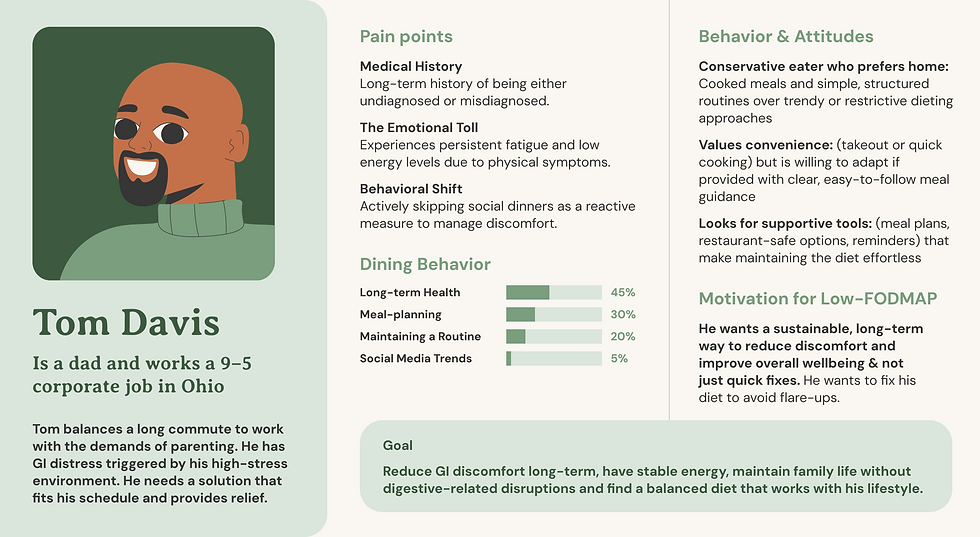
Personas
Maya & Tom



04
Conclusion
Based on Personas


05
Categories
Categories / filters on the app should help users find meals that are safe based on symptoms, meal type, ingredient-based low FODMAP, cooking style, and dietary type

06
User Flow

Maya is tired after a long day and wants the fastest possible path from "I'm hungry" to food at her door. The design goal is zero friction, she shouldn't have to backtrack.


07
Low-Fidelity Design


08
Visual Design


09
High-Fidelity Design


Find a restaurant
Select from Restaurant Menu
Cart + Safety Check
Checkout
Confirmation
10
Product Updates
SCanning
AI integration
-
The app can have a feature that helps users with scanning products off of the shelves of supermarkets to figure out if the product caters to their needs.
-
The user should also be able to save this on the app for future grocery shopping reference.
-
Each product can be represented with distinct color coding (red: danger, yellow: limited quantity, green: safe)
-
The app can have an AI chat that could help users understand their symptoms and helps with initial screening of triggers.
-
This in no way would replace a medical professional or dietitian, but just helps users test out different foods to understand triggers.
-
The AI agent would essentially help the user with substitutes if they have previous triggers (whole milk or certain fruits)